Packback Deep Dives (now: Packback Writing) is an AI writing product we built at Packback, where we led product and engineering before starting Color/Math. It was Packback's work, not a Color/Math engagement, and the incubation model behind it is the one we use with clients today.
A four-person team took it from the start of development to launch in seven months. It pre-booked more than $500K in revenue before it existed, exceeded its development costs the day it launched, and within two years grew into one of Packback's largest revenue lines. It was also a big part of Packback's story when it was acquired in 2024.
The mandate
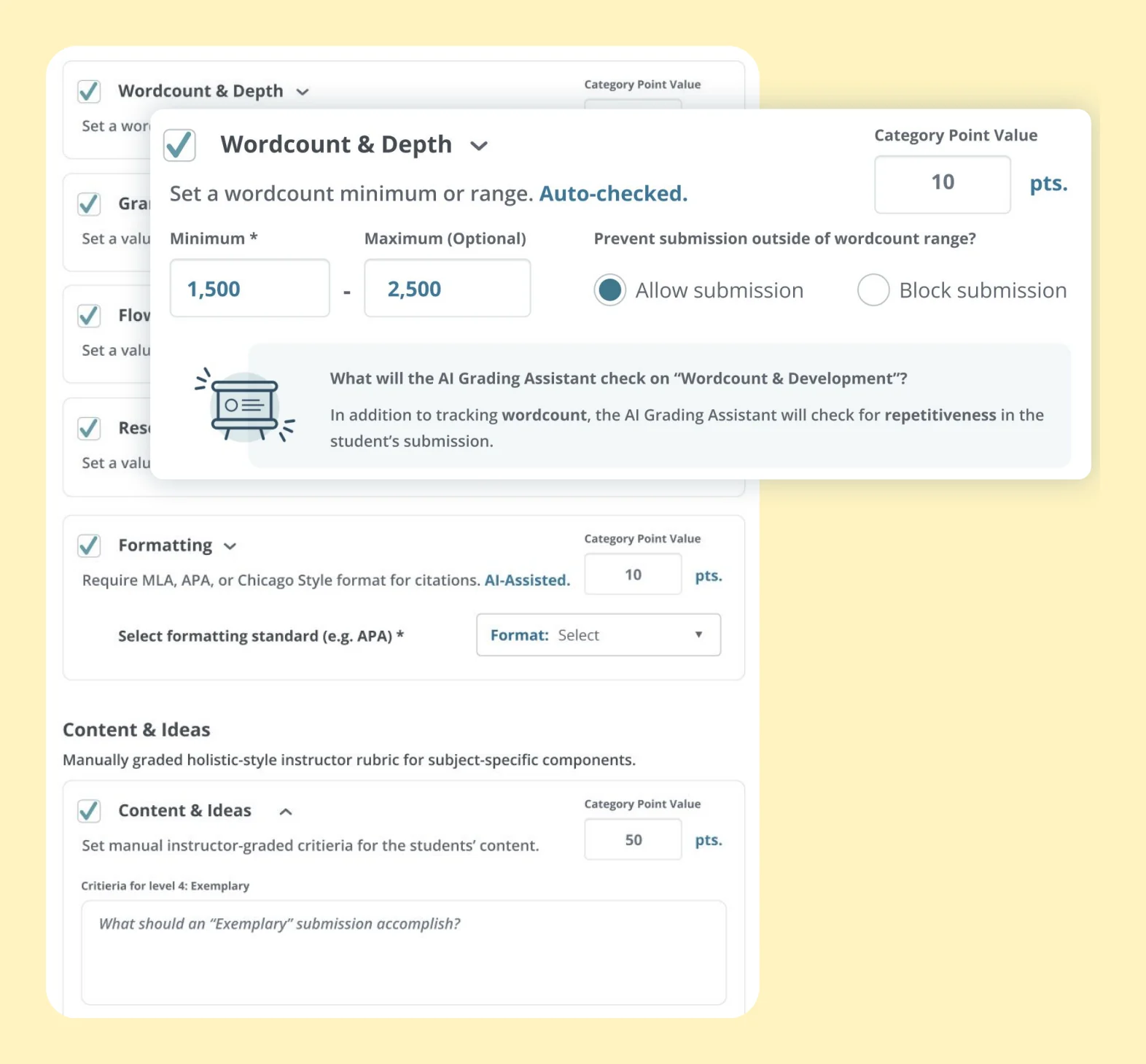
We designed Packback's incubation team to drive new products to market in tight, ROI-based cycles, without pulling the core team's focus from the products customers already relied on. Packback Deep Dives was its first product, and the rule was simple: it had to pay for itself in its first sales cycle. Most fall courses are sold between April and June, so if bookings weren't on track to cover development by June, we would change course.
Demand, proven before development
Instructors had asked for it for years. They wanted the instant feedback students got on Packback Questions (now: Packback Discussions) brought to essays and research papers. We tested that demand before committing a team. A survey of more than 1,500 Packback instructors found that 88% assigned writing, usually worth 25–40% of the grade. A second survey went to 230 instructors who had stopped assigning writing altogether. We asked them why.
“Grading isn't just a week of hell for me; it's a whole semester of hell… It's nights, it's weekends, it's all the time.”
Sixteen discovery interviews with college and K–12 instructors and administrators, run against Figma prototypes, sharpened the problem. Every class held an enormous range of writing ability, and instructors were forced to choose between correcting mechanics and engaging with ideas. The product thesis followed: if software brought every student's writing to a baseline before submission, "every student can be equitably instructed based on the quality of their ideas," and instructors could spend their time on content. It also put two of Packback's product design principles to work: pull feedback "as far forward in the process" as possible, and help "every student reach their next level of growth."
Selling a product that didn't exist yet
Development started in February 2022, and sales started in March. What the sales team sold was a fully clickable Figma prototype. We trained Packback's reps to demo from it, and they were clear with faculty that this was a brand-new product, launching in September, with the caveats that come with that. The prototypes were complete enough to send to faculty, so they could explore the product on their own and answer their own follow-up questions.
Faculty signed up for a first-semester beta, and their students paid for it at a discount to the planned list price. By the time the product shipped, pre-booked revenue had passed $500K, more than it cost to build. We also designed the beta as a structured outcomes study from the start: every participating class surveyed its students and instructors before and after, which became the evidence for the full launch.
A small team and a tight scope
The incubation team was four people at a time, working alongside Packback's core product teams rather than drawing from them. Jessica led product: the Figma design and prototypes, user and market research, and go-to-market. Craig led the technical architecture, including the rules engine behind the highlight-based writing feedback. Two engineers built with us at any given time; we rotated engineers onto the team each quarter, three over the course of the build. To ship on time, we built inside Packback's existing platform, reusing its editor and accounts, and extended its feedback engine so each instructor's own rubric drives the feedback and suggested scores.
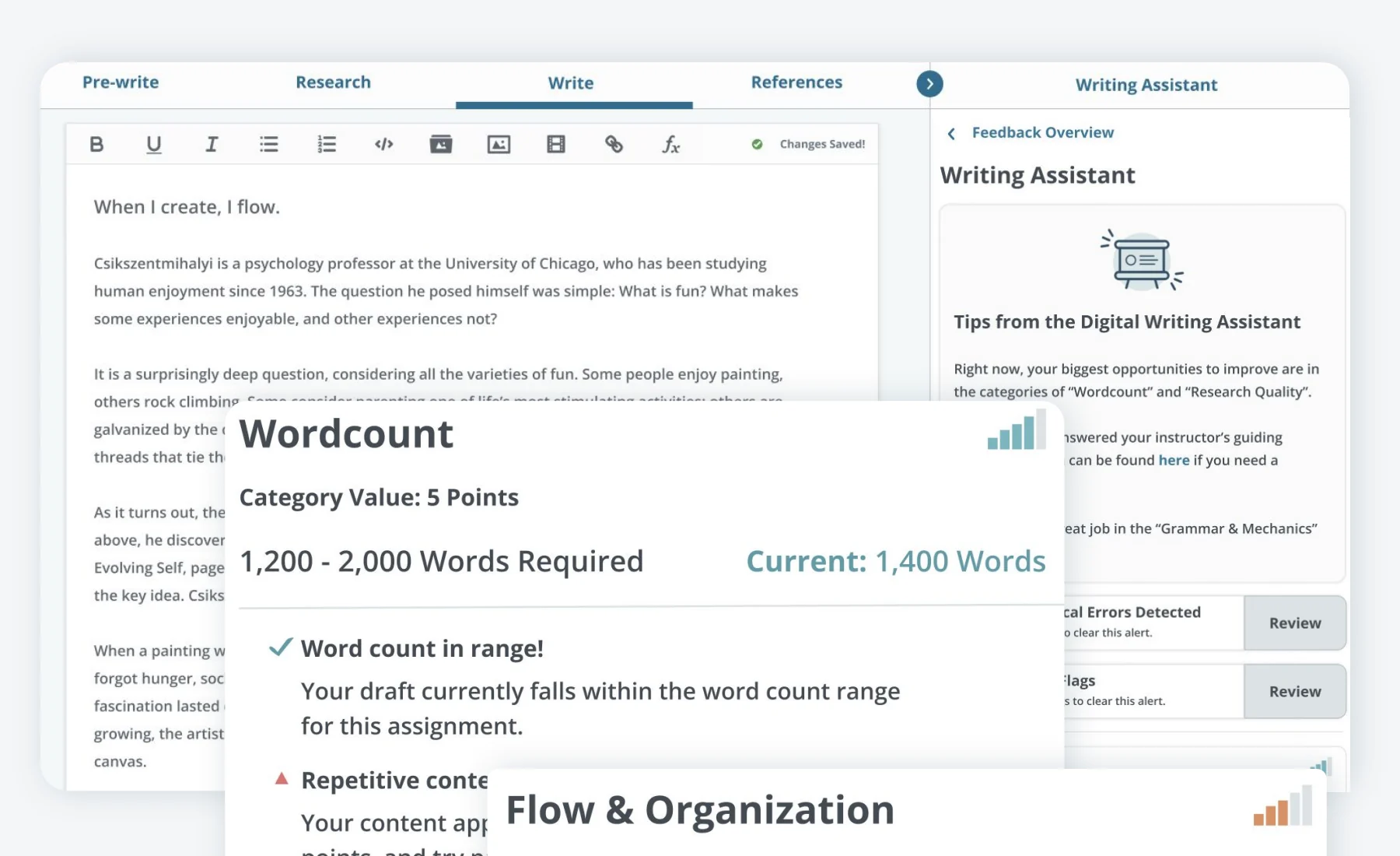
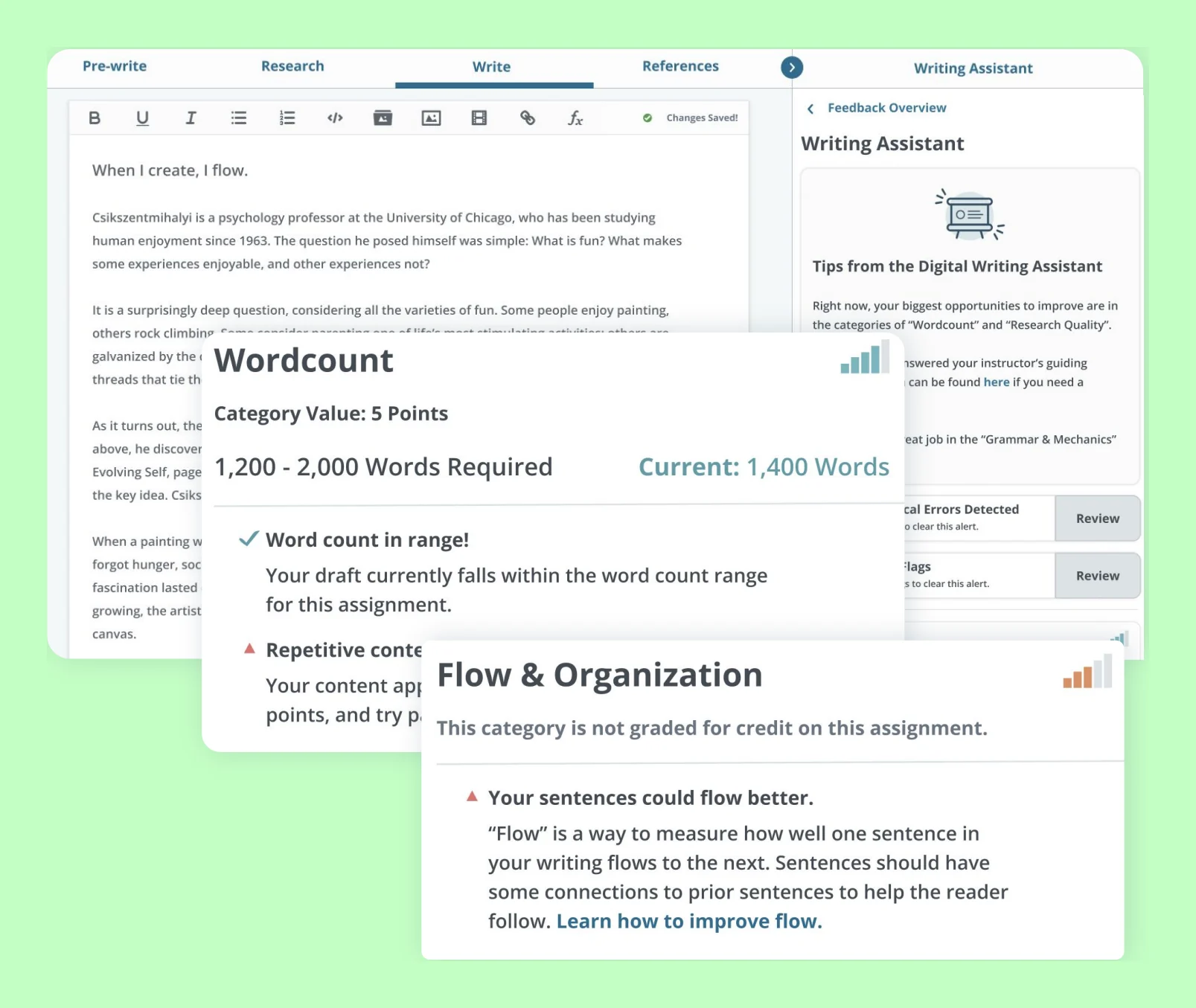
Anything that didn't serve the first release waited. Plagiarism reporting, inline instructor comments and gradebook sync moved to the following spring. The fall release focused on three capabilities. The Digital Writing Tutor gives students rubric-mapped feedback on grammar, flow, repetition and formatting as they write. Students always decide whether to revise; nothing is gated behind the feedback.
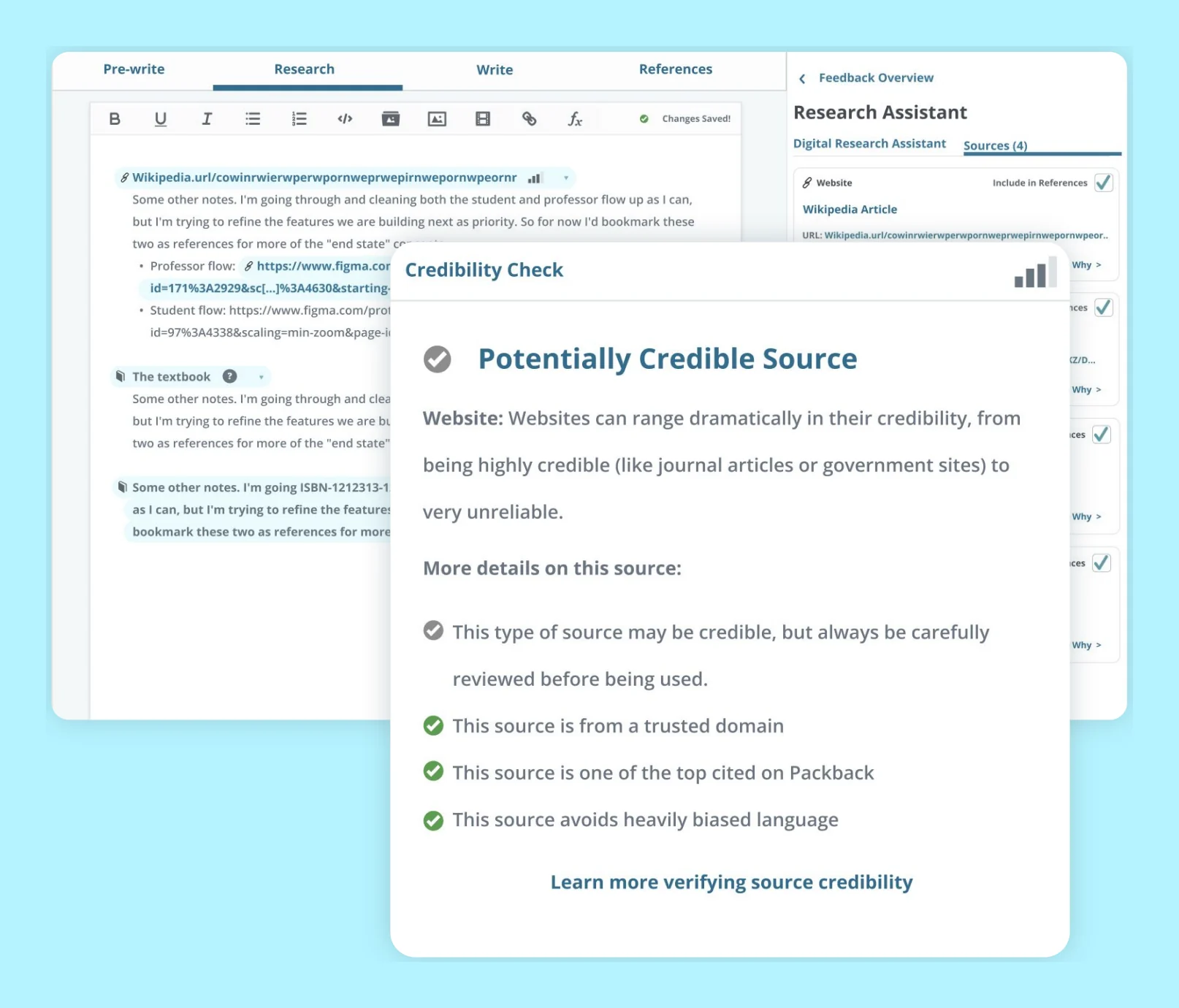
The Digital Research Assistant was the most distinctive of the three. It gives students feedback on the credibility and quality of the sources they cite, in both their bibliography and their research notes, and helps them build each citation. We designed its scoring and feedback behavior together, so it teaches students how to judge a source rather than simply labeling it good or bad.
The Digital Grading Assistant suggests scores for the mechanics categories, which instructors can always override, while they grade the ideas themselves. That was a design principle, too: defer to people, and let instructor overrides beat AI grades.
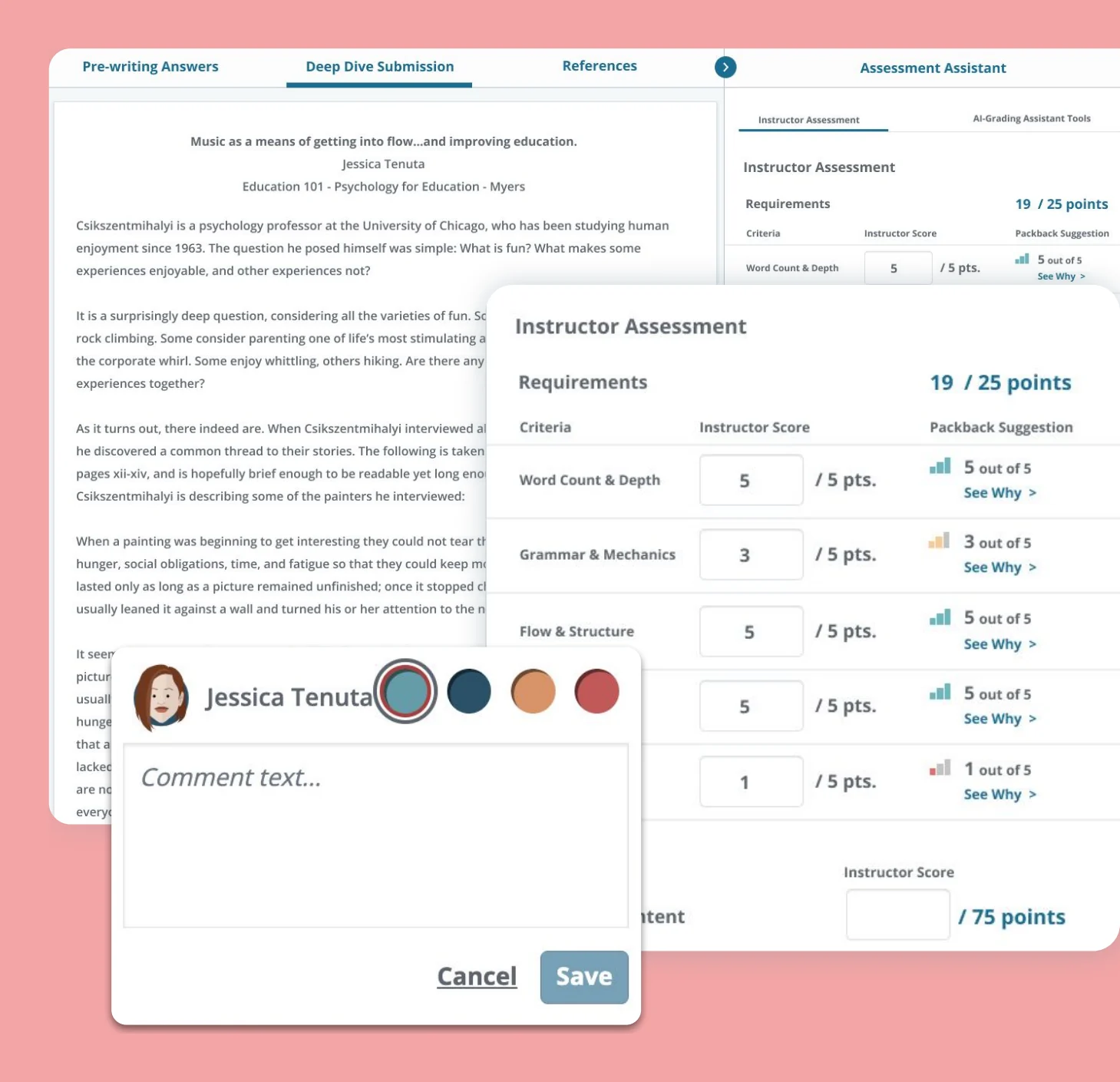
Research shaped the details. Instructors responded far better to "AI suggestions" than to AI scores, and students told us they'd leave for a citation generator if we didn't build one, so automatic citations shipped in the first release. The principle behind it, as we told faculty: "if AI is ever being used to influence a student's grade, it should be 100% explainable."
Results
Packback Deep Dives paid for itself in its first sales cycle: payments that fall exceeded what it cost to build. In its first semester, 14,000 students and 197 instructors used it.
Within two years it had grown into one of Packback's largest revenue lines. More than half of Packback's classrooms used the bundle of discussion and writing, and of the roughly 250,000 students active on Packback each semester, about half completed at least one Packback Deep Dives assignment. Some classes assigned 12 or 13 in a semester. In its first two years, students submitted more than 2 million papers for grading.
When Packback was acquired in 2024, Packback Deep Dives was a big part of the story: it made Packback a full-service, AI-supported writing and discussion solution for both higher ed and K–12. It was the product that resonated most with K–12, so it opened a second market, not just a second product line.
It worked in the classroom, too. In the Fall 2022 study (self-reported, with 612 student and 53 instructor responses and no control group), average grading time per essay fell from 13 minutes to 9, the share of instructors satisfied with their students' writing rose from 42% to 78%, and 88% of students found the AI feedback helpful. Some instructors added writing assignments for the first time. We walked faculty through the first semester's results in a December 2022 webinar.
When generative AI arrived
ChatGPT launched just as Packback Deep Dives finished its first semester, and it actually helped. Teachers were nervous about students writing with AI, and Packback Deep Dives gave them consistent feedback on every paper. That feedback came from algorithms Packback had built and tuned over years, grounded in the academic literature.
We layered generative AI in carefully. Its feedback rules, on style, cohesiveness, whether required elements were present, or prompts like "give feedback on unsupported claims," were mapped to specific types of writing. And it was limited to feedback and Smart Highlights for teachers and students. Generative AI never changed the AI-suggested scores, so it never formally touched a student's grade. Packback's design principles already required it: if AI feedback "has a bearing on their grade, it needs to be simpler, more explainable, and more accurate."
It was also ahead of where regulation was heading. The EU's AI Act now treats AI used to evaluate learning outcomes as high-risk, and Packback Deep Dives had already kept generative AI out of grading and a person in charge of every grade.
How it shapes our work
Packback Deep Dives was the incubation team's first product. Its second, Writing Lab, turned the same feedback into a subscription students could keep after their course ended. The model we designed there is the one we bring to Color/Math: a hard deadline, a clear runway for every bet, requirements tied to whether the product can pay for itself, and a small, dedicated team that sells to real buyers before it writes code.