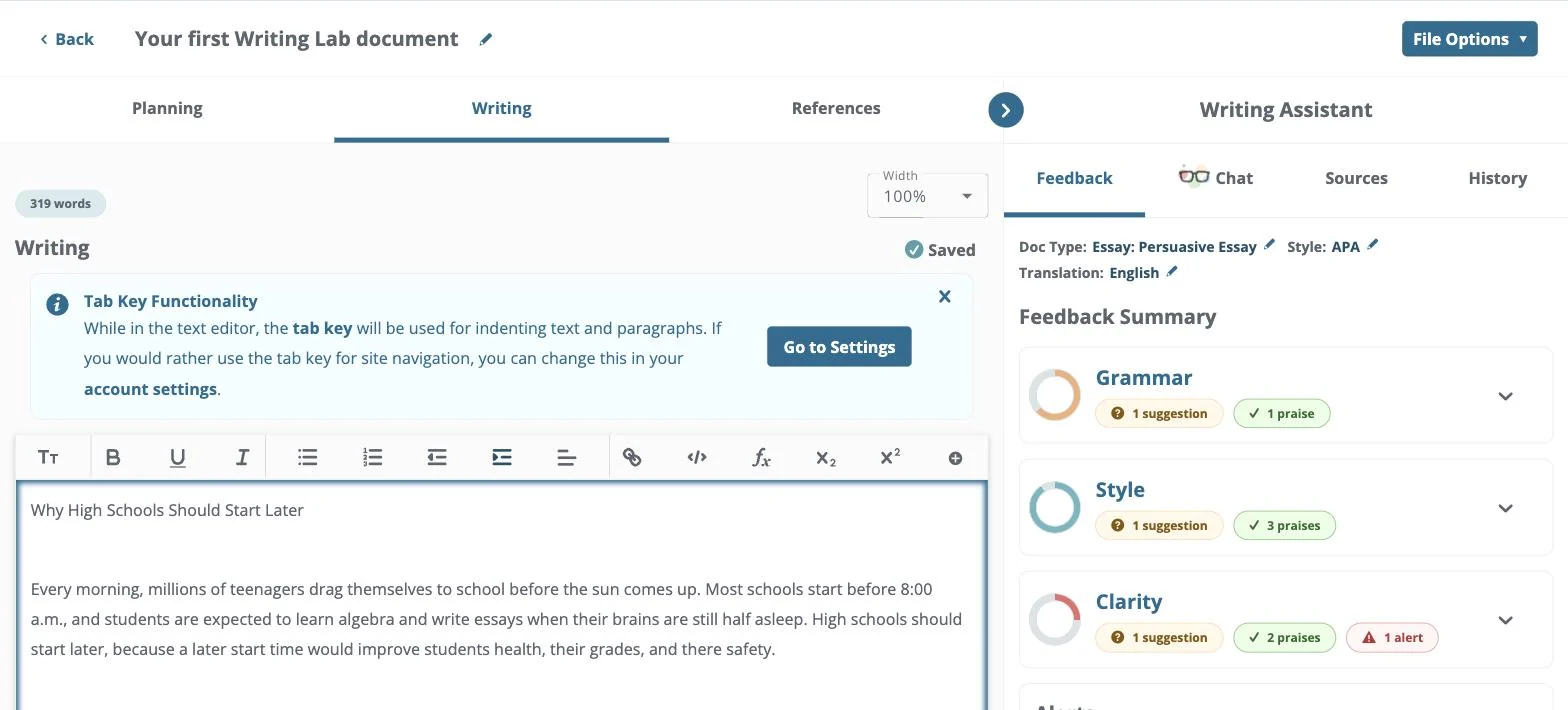
Writing Lab is an AI writing tutor we built at Packback, where we led product and engineering before starting Color/Math. It was Packback's work, not a Color/Math engagement. It was also the second product from the incubation team that built Packback Deep Dives (now: Packback Writing): the two of us, with two engineers newly rotated onto the team.
Feedback locked inside the classroom
Packback Deep Dives and Packback Questions (now: Packback Discussions) gave students instant feedback on their writing, but only in classes where an instructor had adopted Packback. That might be one or two of a student's five classes, while they wrote across all of them. The same limit held the business back: adoption depended on one instructor at a time, which slowed how quickly campuses with a Packback contract put it to use.
We set out to make the feedback available to any student, for any class and any assignment. Then, at the end of 2022, just as the work began, ChatGPT hit the mainstream.
A post-ChatGPT brief
Our student interviews found most students deeply uncomfortable using AI at all. They didn't know how to cite it, or whether it would count as plagiarism. And the tools themselves offered what we called at the time "the beauty and the danger of the ChatGPT user experience": an empty chat box. We designed Writing Lab around three beliefs: AI literacy would become a core skill after graduation, a student's own voice would matter more as decent writing became a commodity, and AI could teach writing rather than do it.
“Students are wondering what these models mean for their future, and if their voice matters. We think their voice matters more than ever.”
Packback's product design principles set the rules. Pull feedback "as far forward in the process" as possible, so students can succeed before they submit. Lead with formative, guiding feedback over corrections. Leave the choice to revise with the student. And treat technology as "an assistant to great instruction, not a replacement."
How it works
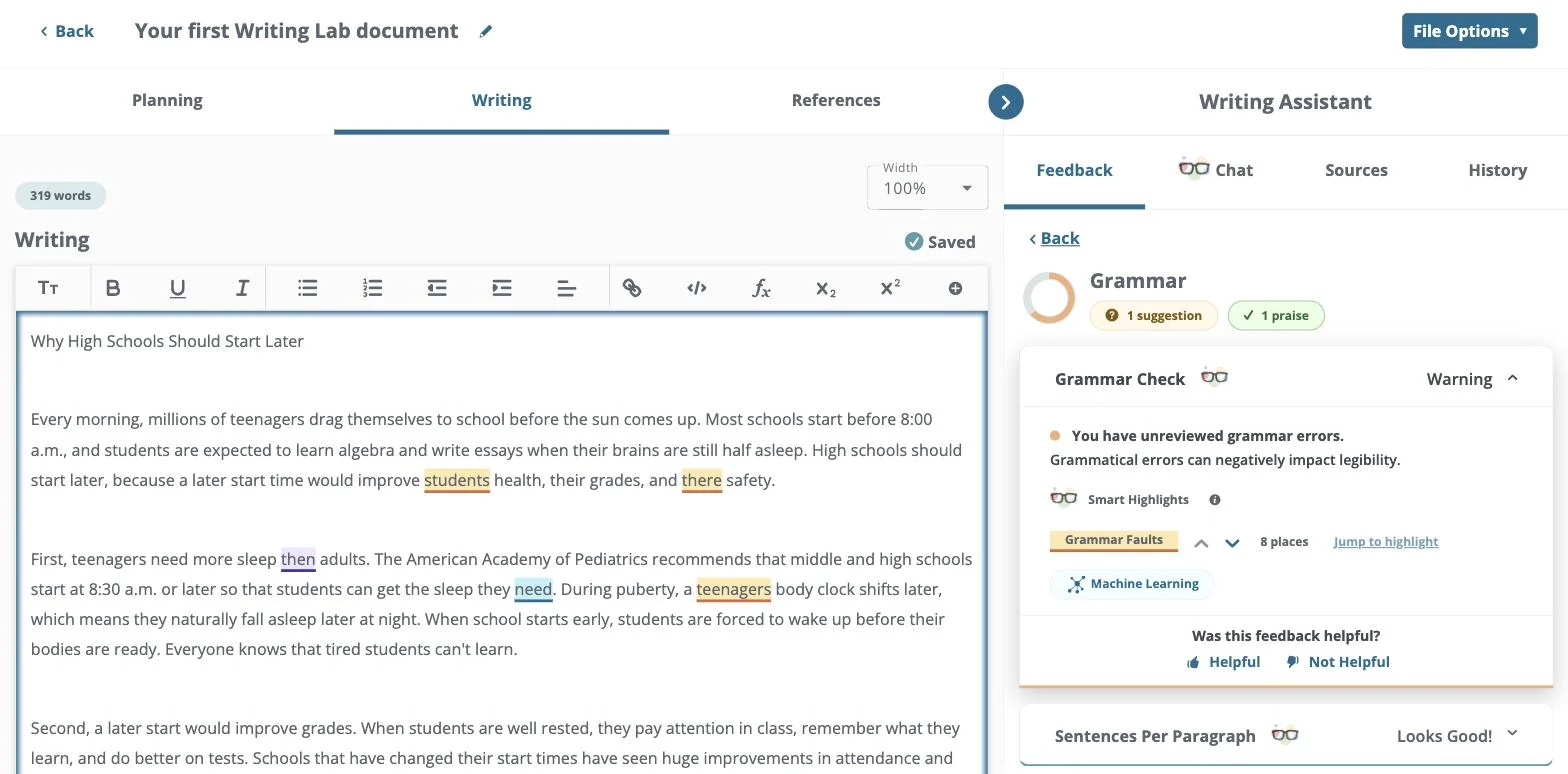
Writing Lab gives every student the feedback that already ran in Packback Deep Dives, tuned to the type of writing. Students choose from 16 document types, from persuasive and argumentative essays to lab reports, memos and reflections. Every piece of feedback is labeled with the kind of AI behind it, and only two kinds ever offer text to accept with a click: grammar corrections and sentence fragments. Everything else teaches the student how to make the change themselves.
The new piece was the Lab Assistant, a chat-based tutor with scaffolded prompts instead of an empty box: help me get started, build an outline, give me holistic feedback on my persuasive essay, help with writer's block, develop my voice. It works only from the student's own words. It will never write the essay, and when a student is stuck it answers with questions.
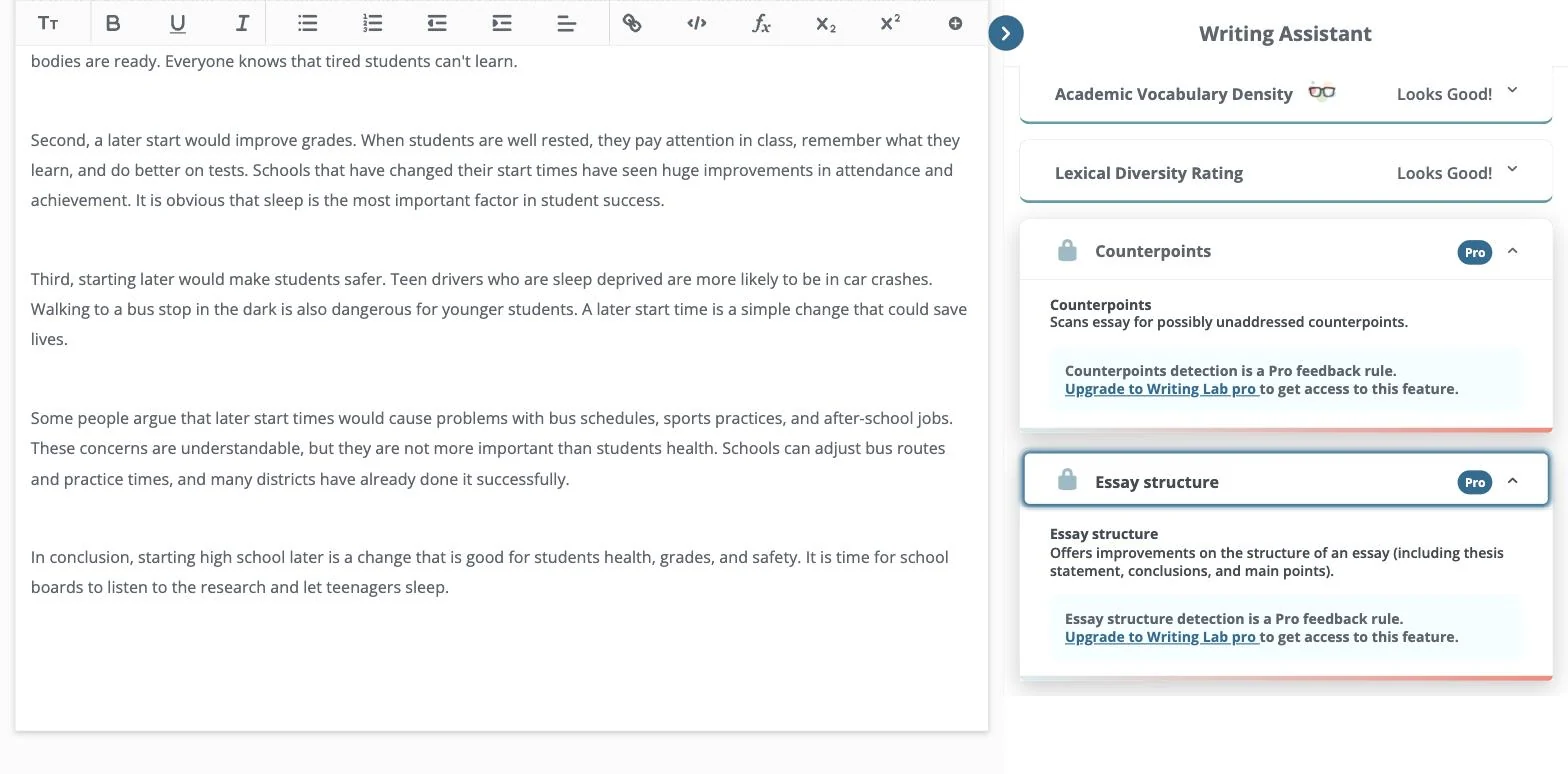
Craig designed it as a conversational agent that both answers questions and proactively offers guidance as a student writes, following the draft and the conversation as they develop. Pro subscribers also get generative AI feedback on the content itself: essay structure, unaddressed counterpoints, unsupported claims, logical fallacies, undefined jargon and tone.
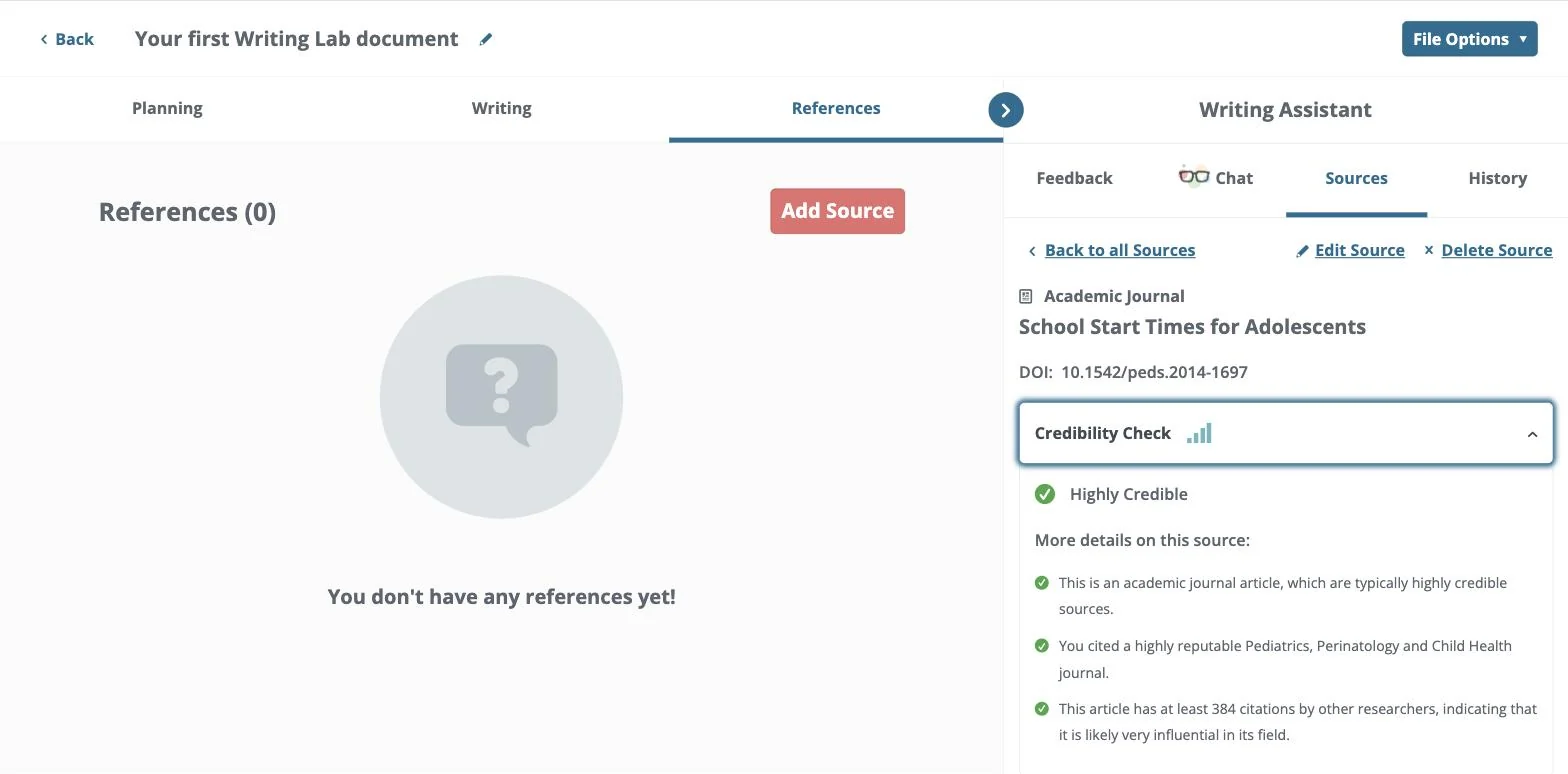
Sources get the same scrutiny as in Packback Deep Dives. Writing Lab rates each source's credibility and explains why, so students learn to judge a source for themselves, and it builds the citation in APA, MLA or Chicago.
Integrity, and then Engagement
Academic integrity was designed in from the start. Writing Lab was built for the student who wants everything they do to be above board, and because it never writes for students, the words they submit are their own. Shortly after launch, we shipped the integrity tools inside Packback Integrity, a product we also led: plagiarism detection, AI detection, and a tool that inserts the missing source when a plagiarism check finds a gap in a student's bibliography.
That product grew into the Packback Engagement suite. Its Playback feature sorts a student's writing activity into time spent orienting, drafting, editing and reflecting, mapped to Barry Zimmerman's model of self-regulated learning. It was always designed to help teachers understand how a student developed their writing, and to show students the same view before they submit, so it's never a gotcha.
Going to market
Writing Lab launched in October 2023 with three routes to market. Students in a Packback course got it free for the length of their course, with a subscription after that. Every school with a Packback contract got it at no added cost, as a campus-wide resource that no longer waited on individual instructors to adopt it. And schools without a contract could adopt it on its own, much as they would a writing tool like Grammarly.
Results
Writing Lab became Packback's first product that every student at a school could use, whether or not their teachers had adopted Packback. It shipped by default to students at more than 500 colleges and universities, and as an opt-in for K–12.
It paid its own way, too. Within the same year it launched, Writing Lab brought in more than $25K in direct-to-student subscription revenue, with no ad spend or sales investment, and it helped Packback win K–12 district contracts that year.
More important, it changed how Packback sold. Writing Lab became one of the main ways Packback sold site-wide to K–12 districts, including some of the largest in the country, in Florida, Texas and California. And it shaped Packback's new product suite, from how it was positioned to how it was priced.
In the wild
The best evidence it worked as designed came from outside Packback. In June 2025, an instructor published their own walkthrough of Writing Lab for their students. When they tell the Lab Assistant they're stuck, it asks what perspective they'll take and builds an outline from their answers.
How it shapes our work
Writing Lab is how we think about product. Every decision had to serve students and Packback's strategy at the same time, and our design principles are what let us decide quickly. The Lab Assistant would never write for a student. Generative AI would never touch a grade. Feedback would come before submission, not after. Settled up front, those calls didn't need relitigating sprint by sprint.
The product then did strategic work, fast. After about six months of building, a tool designed to help students write in their own voice also removed the instructor bottleneck, put Packback in front of every student on campus, opened site-wide sales to K–12 districts, and reshaped how Packback packaged and priced its entire suite.
That's what we bring to Color/Math: principles clear enough to make hard decisions quickly, and products designed to move the business as much as they help the people who use them.